Do I Qualify for EB-1A? The Honest Eligibility Checklist
Last updated: May 15, 2026 · 8 min read
By the Timeline of You team · 8 min read
The most common mistake people make with EB-1A is eliminating themselves before they start. They picture Nobel laureates and Olympic medalists and close the tab. USCIS approves EB-1A petitions for senior engineers, researchers with moderate citation counts, and technical founders — the bar is high, but it's not that high.
The second mistake is the opposite: assuming any impressive-sounding credential clears a criterion. A patent, a conference talk, a senior title at a big company — none of these automatically qualify. USCIS wants specific, documented, externally-recognized forms of distinction. Impressive to your employer is not the same thing.
Here's what the standard actually requires.
The basic threshold
You need to satisfy at least 3 of 10 regulatory criteria — or demonstrate a single major one-time achievement (Pulitzer, Oscar, Olympic medal, that tier). For almost everyone, it's the 3-of-10 path.
Even then, USCIS doesn't stop at the checkbox count. Officers do a final "totality of the evidence" review to confirm you're genuinely among the small percentage at the top of your field. Cases that technically satisfy 3 criteria but lack coherent evidence of distinction get denied here. Weak evidence across many criteria doesn't substitute for solid evidence on a few.
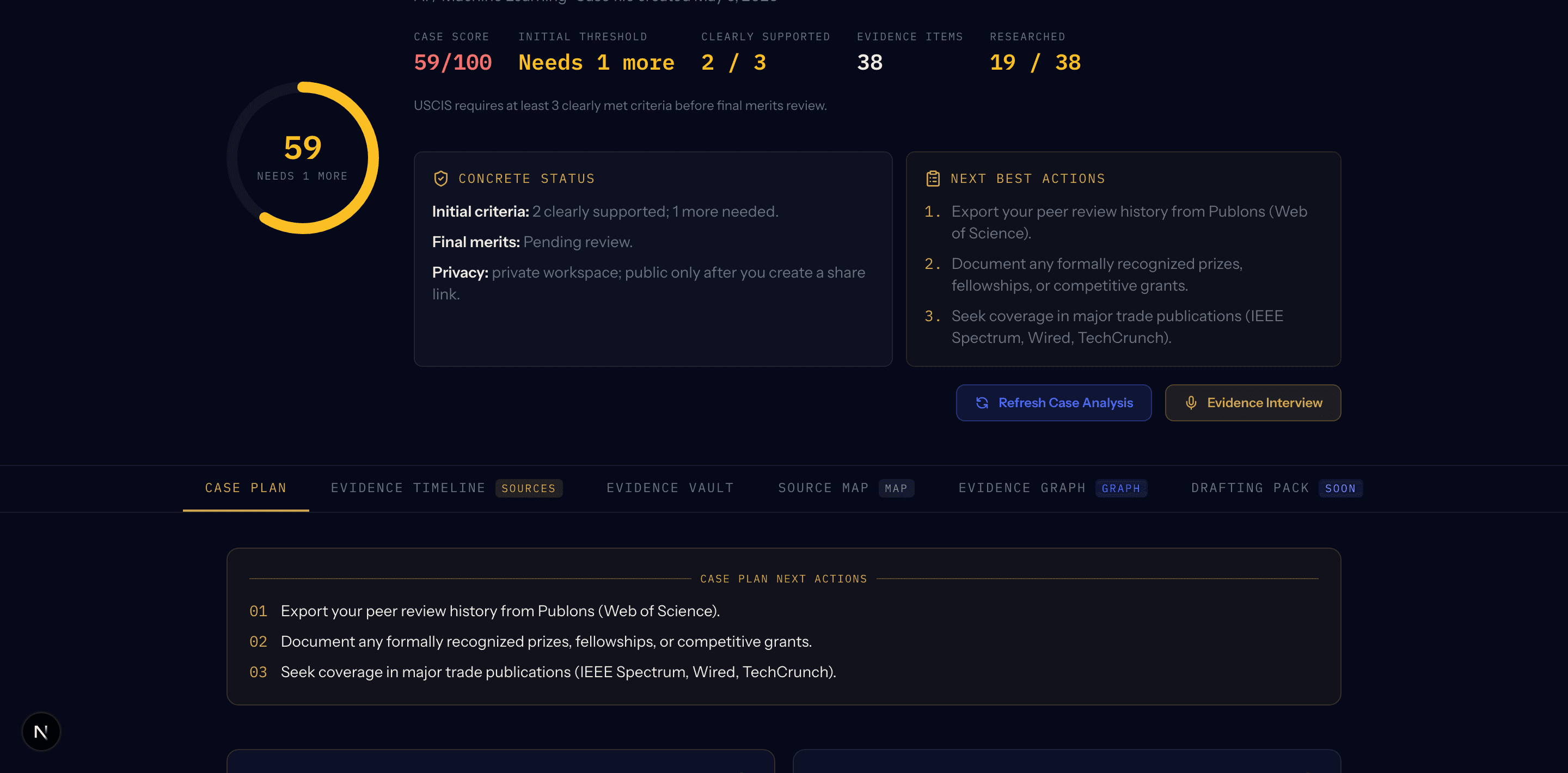
A case workspace mapping evidence across all 10 EB-1A criteria with concrete next actions
The 10 criteria
1. Awards and prizes
You need prizes for excellence judged by recognized experts. Named fellowships, best paper awards at major venues (NeurIPS, ICML, Nature, Science), national science prizes, competition wins with real scope. Employee-of-the-month doesn't qualify. Neither does a hackathon win at your company. The test is whether a committee of external peers selected you as exceptional — not whether your employer thought you did a good job.
2. Membership in selective associations
Membership that required outstanding achievement, assessed by experts. IEEE Senior Member, ACM Senior Member, invitation-only program committees at top conferences. Paying dues to join a professional society doesn't satisfy this. The distinction USCIS cares about is whether getting in required something — nomination, election, peer review of your record.
3. Published material about you in major media
Coverage about you specifically, in major trade or general-interest media. A profile in Wired, IEEE Spectrum, TechCrunch, or MIT Technology Review counts. A university press release doesn't. Your company's blog doesn't. The article has to be written by an independent journalist who chose to cover your work — not something your PR team placed.
4. Judging the work of others
One of the most achievable criteria for researchers, and the most overlooked. Peer review for recognized journals or conferences counts. Grant panel service counts. Get your Publons or Web of Science reviewer record — that's your formal documentation. Saying "I review papers" without a printout is not evidence.
5. Original contribution of major significance
You have to show your work actually influenced the field. Publication alone doesn't do it. A paper with 100+ citations that others built on does. Industry adoption of a technique you created does. Patents being licensed and used do. A paper with 20 citations is a harder argument, even if the work is good.
6. Authorship of scholarly articles
Peer-reviewed publications in your field. The most commonly satisfied criterion for academics and researchers. Venue prestige and citation impact matter more than quantity — three papers in top venues beat fifteen workshop papers without question.
7 & 10. Artistic exhibitions / Performing arts commercial success
Not applicable to STEM, research, or business. Skip both.
8. Critical or essential role in distinguished organizations
Senior or specialized roles at organizations recognized as distinguished in your field. A Principal Scientist at a major AI lab, a Senior Staff Engineer at Google, a technical co-founder at a company with meaningful traction. The organization has to be legitimately recognized — and your specific role has to be senior or specialized, not just titled that way.
9. High salary compared to others in the field
Total compensation — base, bonus, equity — in the top 10–15% for your occupation and metro area. You need an offer letter or pay stub, not a salary estimate, paired with BLS OES data for your specific SOC code and location. Levels.fyi can supplement but won't carry it alone.
How to read your own profile
Most researchers and senior tech workers can realistically claim: judging (if they've peer reviewed at any recognized venue), scholarly articles (if they've published), original contribution (if their work has citations or adoption), critical role (if they're senior at a recognized company), and high salary (if they're in the top tier for their occupation and location).
Three solid criteria with strong documentation is enough. Five mediocre criteria isn't. A case built on documentation gaps and weak evidence will fail the totality review even if it clears the criterion count.
What makes a case weak even with 3+ criteria
The totality review is where cases that technically work on paper fall apart. Common failure patterns: all evidence from a single employer (no external peer recognition), early career credentials with nothing recent, every criterion satisfied at the minimum threshold without a single clearly strong one, and a field defined so narrowly that "top of field" loses meaning.
You want at least one criterion that's clearly, inarguably met — and supporting evidence that shows external recognition, not just internal performance.
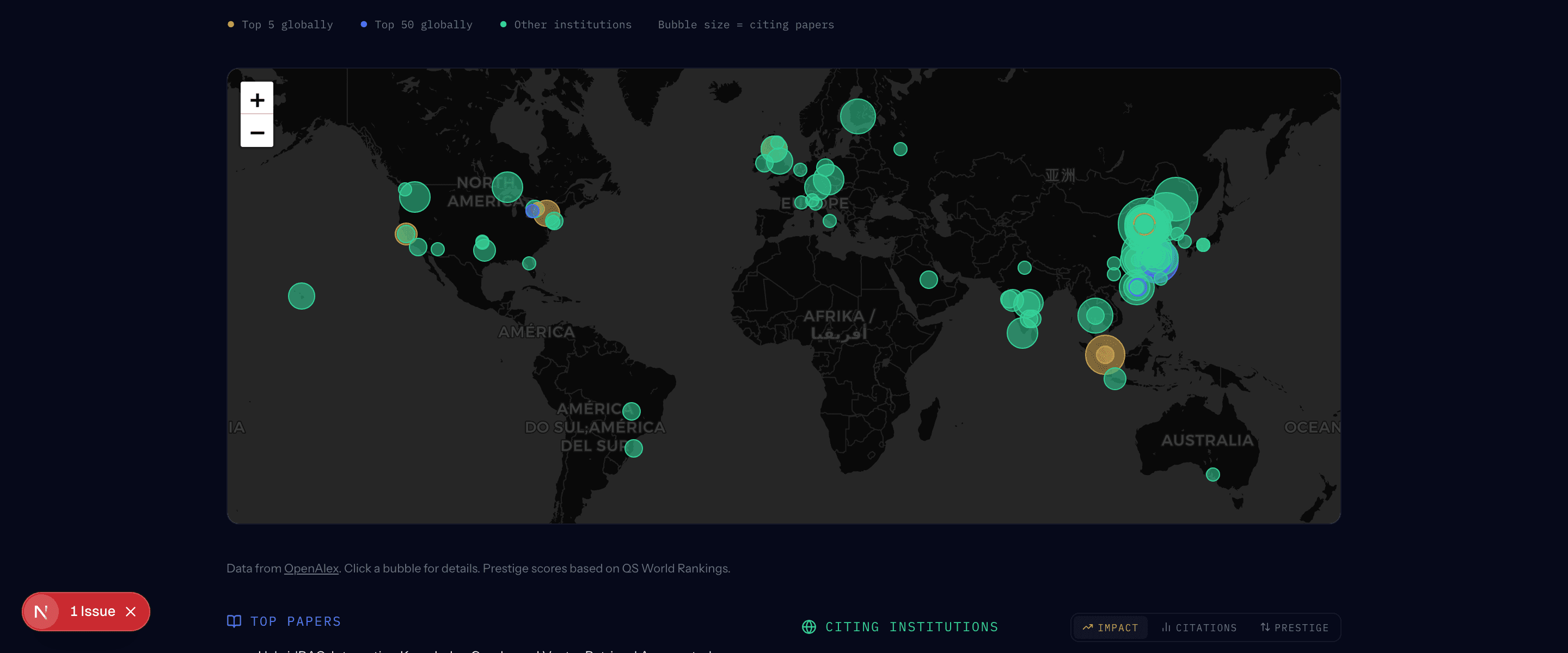
Citation network automatically built from public research data — 104 citing institutions across 23 countries
See how your actual profile maps
Enter your background and get a readiness score across all 10 EB-1A criteria with specific gap explanations. Free, private, takes 3 minutes.
Get my free EB-1A assessment →EB-1A Strategy Guide
Get notified when we publish new guides
Practical EB-1A strategy for researchers, engineers, and founders. No spam.
Related Guides
All 10 EB-1A Criteria Explained With Real Examples
A plain-English breakdown of every USCIS extraordinary ability criterion — what counts, what doesn't, and how to document each one.
12 min →
EB-1A for Tech Workers and AI Researchers: A Practical Guide
How engineers, ML researchers, and technical leads can build a compelling EB-1A case — which criteria map best to a tech career.
10 min →
EB-1A Approval Rates: What the Data Actually Shows
USCIS approval rates for EB-1A broken down by year, field, and petition type — and what the numbers mean for your case.
6 min →