Getting an EB-1A RFE: What It Means and How to Respond
Last updated: May 17, 2026 · 8 min read
By the Timeline of You team · 8 min read
You filed your EB-1A petition. Weeks or months later, USCIS sends you a thick envelope instead of an approval. It's a Request for Evidence — an RFE. The initial reaction is usually panic. It shouldn't be. An RFE is not a denial, and roughly 60–70% of well-responded RFEs end in approval.
What it is: USCIS is telling you they weren't convinced by something specific in your filing. Your job is to figure out exactly what that is, and fix it with better evidence — not just more of the same evidence.
The Numbers First
Roughly 30–36% of EB-1A petitions receive an RFE — so if you got one, you're in significant company. The rate fluctuates with adjudicator policy and filing volume. Under stricter adjudication eras (USCIS policy goes through cycles), that number has been as high as 40%.
You have 87 days from the date on the RFE to respond. Not from when you received it — from the date printed on the document. USCIS mails RFEs via USPS; factor in a few days of mail time. In practice you have closer to 80 usable days. That sounds like a lot. It is not a lot if you need to track down new expert letters, obtain additional documentation, and draft a detailed legal brief.
Can you request an extension?
USCIS rarely grants RFE extensions. They're permitted by regulation but discouraged in practice. Assume you have 87 days. Build your response timeline from day one of receiving the RFE.
The Three Most Common EB-1A RFE Types
USCIS doesn't explain their reasoning well. An RFE might be 12 pages of boilerplate with two sentences that actually tell you what they want. Here are the three archetypes you'll encounter:
Type 1
A claimed criterion looks thin
What USCIS is saying
USCIS is not convinced one evidence category meets the legal standard.
Strong response
Add qualitative proof: independent expert context, downstream adoption, and before/after impact.
Avoid
Sending the same citation count or the same letter language again.
Type 2
The totality argument is not landing
What USCIS is saying
You may meet three boxes, but USCIS is not yet persuaded you sit near the top of the field.
Strong response
Rewrite the case narrative so the evidence compounds into one clear extraordinary-ability story.
Avoid
Treating the response like a document dump with no final argument.
Type 3
Your field is being narrowed
What USCIS is saying
USCIS is defining your field more tightly than you did, making your evidence look less broad.
Strong response
Use independent letters and adjacent-field evidence to defend the correct field definition.
Avoid
Arguing prestige in a broad field without proving your work travels beyond a niche.
Type 1: Insufficient Evidence for a Claimed Criterion
This is the most common. You claimed you meet, say, the “original contributions of major significance” criterion, and USCIS didn't buy it. The RFE will typically say something like: “The petitioner has not established that the claimed contributions have had a major impact on the field.”
The mistake most people make in response: submitting more of the same. More citation counts, more references to the same papers. USCIS already saw that evidence and wasn't convinced. What they want to see is qualitative context, not quantitative quantity.
What actually works: Expert letters that explain specifically why your contribution matters to someone who didn't know your name before they read the letter. The letter should describe the state of the field before your work, what you did differently, and the measurable effect. “Dr. X's paper introduced Y technique, which our team then adapted in our production system — reducing inference latency by 40%.” That's impact. “Dr. X's work is highly cited and well-regarded” is not.
Type 2: The Totality Challenge
You cleared the three-criterion threshold — USCIS accepts that you've technically met at least three criteria — but they still issue an RFE saying they're not satisfied that you're “one of that small percentage who has risen to the very top of the field.”
This is the harder RFE to respond to because it's not about a specific piece of evidence — it's a holistic judgment. USCIS is saying: you have the minimum criteria, but we don't believe you're truly extraordinary.
What actually works: A strong “totality of evidence” brief that weaves together all your evidence into a narrative. Think of it as a final argument — not a list of documents, but a story about who you are in your field. What problems you've solved that nobody else was solving. Who in your field knows your name and why. What the field looks like differently because you were in it. This often requires additional expert letters specifically addressing the totality question (not just one criterion).
Type 3: Field Definition Challenge
Less common but particularly frustrating. USCIS defines your field more narrowly than you did, and argues that within that narrow definition, your evidence doesn't hold up. For example: you're a machine learning researcher and claimed expertise in “artificial intelligence,” but USCIS says your evidence only covers “computer vision” specifically. Or you're a software engineer who filed in the “business of software engineering” and USCIS wants to narrow it to just your specific product area.
What actually works: Expert letters that explicitly confirm your role in the broader field, not just the subfield. And, if needed, additional evidence from the broader field — reviewing papers across the broader discipline, invitations to speak on general conference tracks, citations from researchers in adjacent subfields who build on your work.
How to Structure a Strong RFE Response
A good RFE response has three components:
Point-by-point rebuttal
Address each USCIS concern directly, using their language
Ignoring specific objections or restating the original brief
New evidence
Documentation that specifically fills the identified gap
Submitting duplicates of evidence already rejected
Totality narrative
A unified argument for why you meet the extraordinary ability standard overall
Treating the response as just an evidence dump
The brief itself matters. A well-written RFE response isn't just an evidence index — it's a legal argument, organized around USCIS's own standards (the Matter of Kazarian framework, plus any relevant AAO decisions). The officer reading your response may not have strong technical background. Your argument has to be clear to a non-expert.
When to Get an Attorney (Even If You Filed Pro Se)
If you filed your original I-140 without an attorney, an RFE is a reasonable point to bring one in. The cost is typically $3,000–$6,000 for RFE response preparation — not cheap, but consider what's at stake. A denial after a poor RFE response means starting over.
Signs you probably should get an attorney for the response:
- The RFE challenges the totality of your evidence, not just one specific criterion
- You received a Type 2 (totality) challenge — these require experienced legal drafting
- The RFE uses language you don't recognize or can't parse (AAO precedent citations, obscure regulatory sections)
- Your case is borderline and you were surprised by the RFE
Signs you might handle it yourself (with good resources):
- The RFE is narrow — missing a specific document, or one criterion not substantiated
- You can clearly identify the gap and fill it with documentary evidence
- You have strong writing skills and time to research AAO case law
What Makes a Weak RFE Response
Since ~30–40% of RFE responses don't result in approval, it's worth being specific about failure modes.
Submitting more of the same evidence. If USCIS said your 200-citation paper wasn't convincing enough evidence of major significance, sending your citation count updated to 220 won't move the needle. You need qualitative evidence explaining why those citations matter, not more of the same quantitative evidence.
Not addressing the specific objection. USCIS RFEs are often verbose, but there are usually 2–4 core objections buried in the boilerplate. If you respond comprehensively to everything except the actual concern, you'll get a denial on that exact point.
Expert letters that echo the original letters. If you had six letters in your original petition, adding two more from similar people saying similar things is not an upgrade. The new letters need to add something: a different perspective, a more senior expert, someone addressing the specific criterion USCIS doubted, or someone from outside your immediate professional network.
Missing the deadline. This one sounds obvious. It happens. USCIS won't accept late responses, and the resulting denial is treated identically to a denial on the merits. Track the deadline from day one.
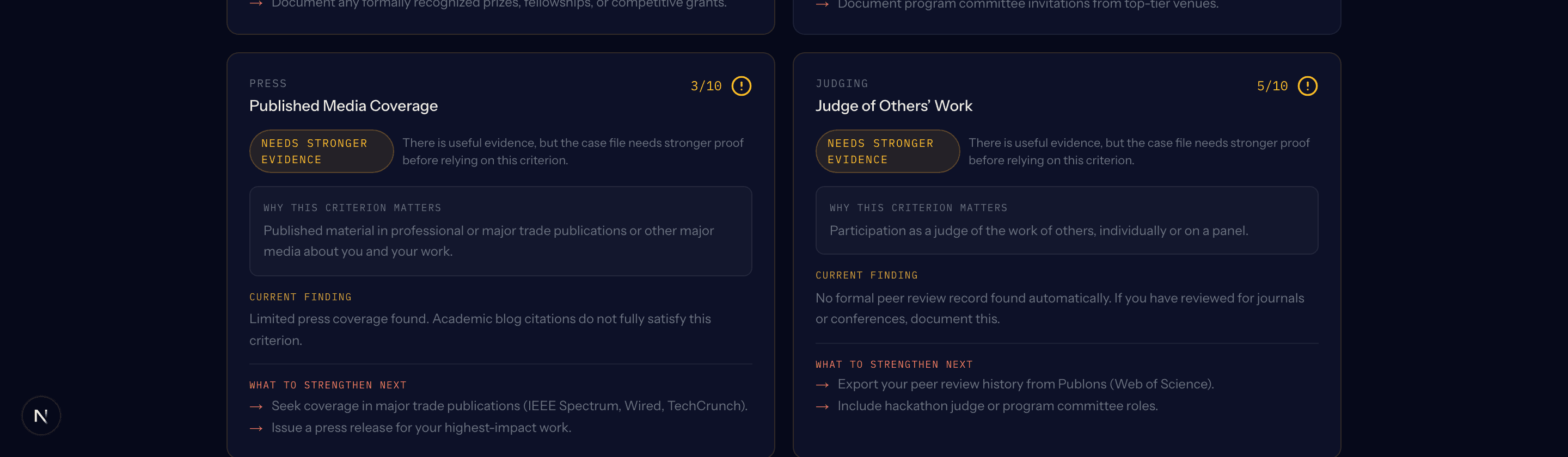
Timeline of You's case planning view shows evidence gaps before you file — the same gaps USCIS is likely to flag in an RFE. Knowing them in advance means you can fix them before the RFE, not after.
The Best RFE Strategy Is Not Needing One
None of this is meant to be discouraging. RFEs are common, manageable, and often result in approvals. But the best outcome is filing a petition so complete that USCIS doesn't feel the need to ask for more.
The evidence gaps that generate RFEs are predictable. They're usually the same gaps you could identify by reading your own petition critically before filing: criteria that are thinly supported, expert letters that are generic, citation evidence without qualitative context, or a totality narrative that doesn't connect the dots.
Filing well means doing the harder work upfront — and it's work that has a high return on investment, measured in months of uncertainty avoided.
Know your evidence gaps before USCIS does
Free assessment maps your background against all 10 EB-1A criteria — takes 3 minutes. Catch the gaps before they become an RFE.
Get my free EB-1A assessment →EB-1A Strategy Guide
Get notified when we publish new guides
Practical EB-1A strategy for researchers, engineers, and founders. No spam.
Related Guides
EB-1A Approval Rates: What the Data Actually Shows
USCIS approval rates for EB-1A broken down by year, field, and petition type — and what the numbers mean for your case.
6 min →
Filing EB-1A Without an Attorney: What's Actually Involved
EB-1A self-petitions are legal and increasingly common. Here's what pro se filing actually requires and where people get it wrong.
8 min →
EB-1A for Tech Workers and AI Researchers: A Practical Guide
How engineers, ML researchers, and technical leads can build a compelling EB-1A case — which criteria map best to a tech career.
10 min →