Why 4 Strong Criteria Beat 7 Weak Ones: The Ultimate EB-1A Strategy
Last updated: May 18, 2026 · 6 min read
By the Timeline of You team · 6 min read
There is a common misconception among EB-1A hopefuls that the more criteria you claim, the better your chances. If you need 3 to pass, why not claim 7 just to be safe? The reality of how USCIS adjudicates these petitions proves the exact opposite.
The smartest applicants—and the best attorneys—don't throw everything at the wall to see what sticks. Instead, they consolidate their evidence into 3 or 4 absolute, unbreakable pillars. Here is why submitting four bulletproof criteria is fundamentally better than scraping together seven weak ones.
The Psychology of an Adjudicator
Imagine you are a USCIS officer. You have a stack of hundreds of petitions to get through. You pick one up, and the applicant claims they meet 8 out of 10 criteria.
You turn to the "Awards" criterion, and you see they submitted a company-internal "Employee of the Month" certificate. Instantly, your skepticism skyrockets. If the applicant believes an internal company award qualifies as a "nationally or internationally recognized prize," what does that say about their judgment on the rest of the petition?
Weak criteria dilute your strong criteria. When an officer easily dismantles your first two weak claims, they carry that skepticism into the rest of your file. They start looking for reasons to deny, rather than reasons to approve. By the time they reach your truly strong evidence, the narrative of "extraordinary ability" has already been poisoned.
The Golden Rule
Never force an adjudicator to read through weak evidence. If you wouldn't comfortably bet your approval on a specific criterion standing up to intense scrutiny, drop it entirely and reallocate that evidence.
Consolidation: Making Your Evidence Bulletproof
Instead of spreading your evidence thin across many categories, you can often subsume evidence into your strongest pillars. This is the strategy used by top-tier immigration firms.
Let's say you have an article published about your work in a medium-sized niche blog, and you were invited to speak at a local tech conference. Neither of these individually meet the high bar for "Published Material" or "Display at Artistic Exhibitions" (which rarely works for tech anyway).
But what if you use that blog post and that speaking engagement as supporting evidence for your "Original Contributions of Major Significance" criterion? Suddenly, that blog post isn't a failed press claim; it's objective proof that the industry is talking about the significance of your contributions.
The Kazarian Test (Final Merits Determination)
The EB-1A process is a two-part test. Part 1 is the objective criteria (meeting 3 out of 10). Part 2 is the Final Merits Determination, also known as the Kazarian test. This is where the officer looks at the "totality of the evidence" to decide if you are truly at the top of your field.
This is where the 4-criterion strategy shines. If you pass 4 criteria with overwhelming, independent evidence—for example, high salary, a critical role at a Fortune 500 company, judging international panels, and highly cited patents—the Final Merits test takes care of itself. The narrative is cohesive: you are a highly paid, critically important expert who guides the industry and creates new technologies.
Conversely, an applicant who barely scrapes by with 3 borderline criteria (e.g., low-level judging, a couple of weak publications, and a minor award) will often pass Part 1, only to be hit with a brutal denial in Part 2 because the "totality of the evidence" doesn't scream extraordinary ability.
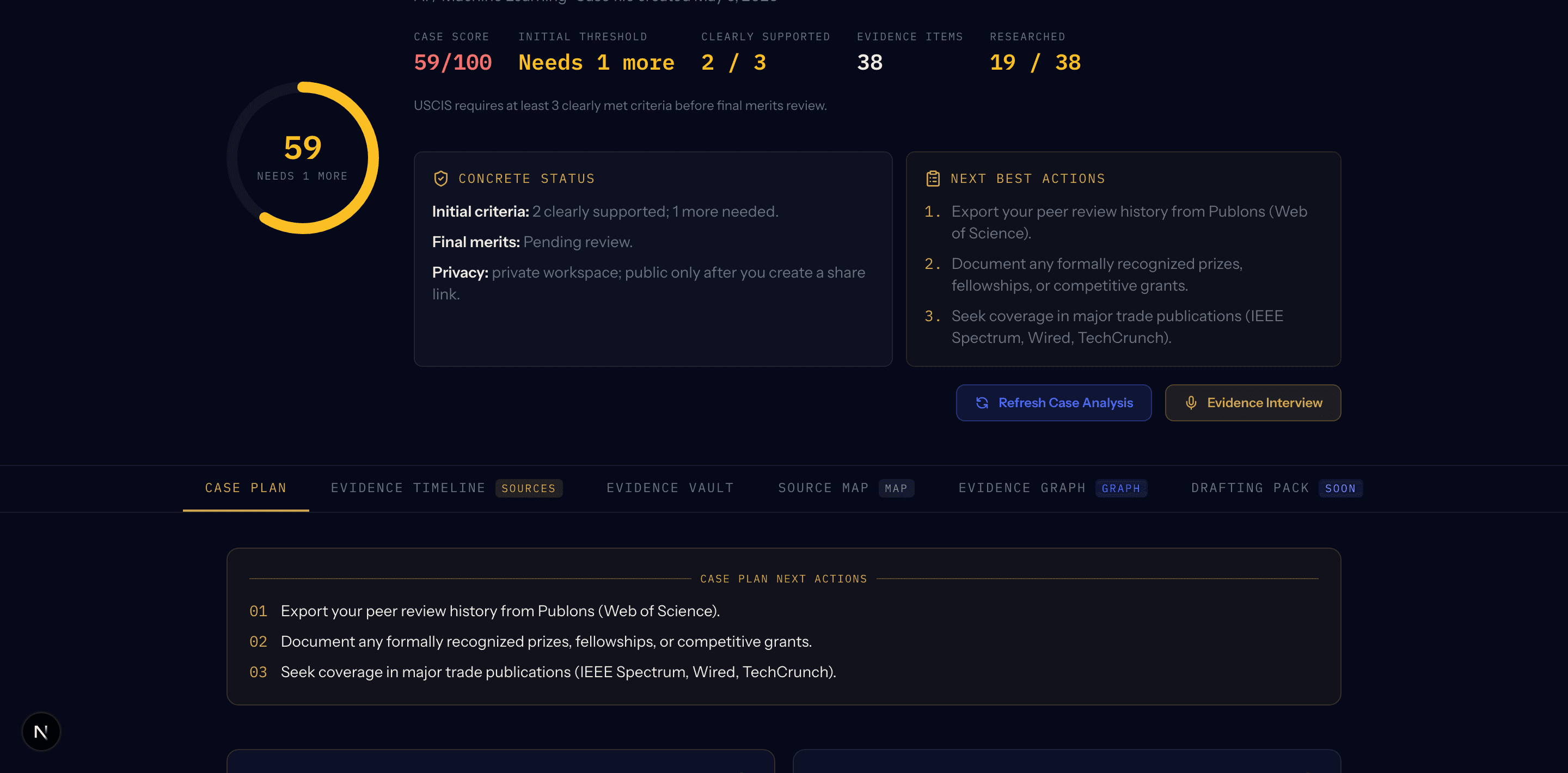
Timeline of You’s AI scoring engine correctly models probability based on the strength of your top criteria. A profile with 4 exceptionally strong criteria will score higher than a profile with 7 weak ones.
Independent Evidence is King
When building your 3 or 4 pillars, focus on independent adoption. USCIS expects your employer to praise you. But what happens outside your company walls?
If you are an industry executive or engineer, the strongest evidence you can provide is external validation. Are competitors citing your patents? Have organizations across multiple countries adopted your open-source framework? Do you have sworn letters from experts who have never met or worked with you, but know you entirely by reputation?
Consolidating this independent evidence into 4 unbreakable criteria is the ultimate industry strategy. Quality always beats quantity. Find your strongest pillars, stack your evidence under them, and don't give the adjudicator a single reason to doubt your ability.
Is your profile strong enough?
Timeline of You’s AI engine evaluates your evidence using the same logic as a USCIS adjudicator. See if your 3 or 4 criteria are strong enough to pass the Final Merits test.
Start your free evaluation →EB-1A Strategy Guide
Get notified when we publish new guides
Practical EB-1A strategy for researchers, engineers, and founders. No spam.
Related Guides
All 10 EB-1A Criteria Explained With Real Examples
A plain-English breakdown of every USCIS extraordinary ability criterion — what counts, what doesn't, and how to document each one.
12 min →
EB-1A for Tech Workers and AI Researchers: A Practical Guide
How engineers, ML researchers, and technical leads can build a compelling EB-1A case — which criteria map best to a tech career.
10 min →
Do I Qualify for EB-1A? The Honest Eligibility Checklist
Most people are wrong about their EB-1A chances — in both directions. Here's the concrete checklist USCIS actually uses.
8 min →