EB-1A for Indian Nationals: The No-Country-Cap Advantage
Last updated: May 17, 2026 · 8 min read
By the Timeline of You team · 8 min read
The EB-2 priority date for India is currently backlogged by roughly 195 years. That's not a typo. An Indian engineer filing an EB-2 NIW petition today, with a priority date in 2026, would need to wait until approximately the year 2221 for their priority date to become current. They will not receive a green card in their lifetime. Their children might not either.
EB-1A, by contrast, has no per-country cap. Priority dates are currently current for all countries of birth, including India. An Indian engineer who qualifies for EB-1A and files today can have a green card in 12–18 months. Same job, same country, completely different outcome.
This is the single most important strategic fact in US immigration for Indian-born tech workers right now.
195+ years
EB-2 India backlog
A 2026 priority date is not a realistic lifetime green-card path for most applicants.
Current
EB-1A priority dates
If the I-140 is approved, adjustment of status can move immediately while dates stay current.
12-18 months
Realistic EB-1A green-card window
Premium processing plus adjustment can turn qualification into actual work freedom quickly.
Why the Backlog Is This Bad
US immigration law allocates a fixed number of employment-based green cards per year — roughly 140,000 — and limits each country of birth to 7% of the total. With ~140K cards and 7% cap, that's roughly 9,800 green cards per year across all employment categories for India-born applicants.
The demand from Indian-born applicants in EB-2 and EB-3 vastly exceeds supply. The backlog has been growing for decades. There is no legislative fix in sight. The math simply doesn't work. People who understood this a decade ago and chose EB-1A paths are now permanent residents. People who filed EB-2 NIW in 2020 are still waiting.
EB-1A (Extraordinary Ability)
Current (no wait)
12–18 months
EB-1B (Outstanding Researcher)
Current (no wait)
12–20 months
EB-2 NIW (National Interest Waiver)
195+ years
Not in your lifetime
EB-2 PERM (Employer-sponsored)
195+ years
Not in your lifetime
EB-3 (Skilled Worker)
10+ years
2035+ at best
The EB-1 category (which includes EB-1A) is exempt from per-country backlogs at the priority date level. Once your I-140 is approved, you can immediately file for adjustment of status — regardless of whether you were born in India, China, or anywhere else. The path is open.
What This Means for Career Decisions
The H-1B system is designed around employer sponsorship. You can't easily change jobs without an H-1B transfer. You can't do independent consulting without a separate visa. You can't join a startup without confirming they can sponsor your H-1B. You can't be laid off without a specific grace period and a plan.
For someone on H-1B with an EB-2 NIW petition filed, the situation is: they have a pending petition that proves they qualify for a green card, and they will still be waiting indefinitely. They cannot take the career risks that would grow their reputation and compensation because every major move requires confirming it doesn't jeopardize their visa status.
An EB-1A green card, obtained in 12–18 months, ends this. Work anywhere. Work for yourself. Negotiate without the shadow of visa dependency. Take the startup equity role. Leave the dysfunctional team. The compounding value of that freedom — over a career — is enormous.
The H-1B context in 2026
H-1B policy uncertainty has increased significantly in recent years. Lottery odds have worsened, RFE rates have fluctuated, and policy changes have created additional friction. For Indian engineers who didn't win the H-1B lottery on the first try, or who are nearing the end of their 6-year limit with no green card in sight, EB-1A is increasingly not optional — it's the primary exit strategy from visa dependency.
Common Concerns From Indian Tech Workers (And the Real Answers)
“I don't have a PhD.” A PhD is not required for any of the 10 EB-1A criteria. Most criteria don't reference educational credentials at all. The relevant question is whether your contributions and recognition are at the top of your field — not what degree you hold. Many approved EB-1A petitioners in tech are bachelor's degree holders with strong industry track records.
“I haven't published academic papers.” Four of the 10 EB-1A criteria have nothing to do with publications: high salary, critical role in distinguished organization, judging others' work (which includes code review at scale, grant panel participation, competition judging), and awards. You can meet three criteria without a single academic paper. It's harder, but it's done regularly.
“I'm not famous enough.” EB-1A requires being at the “top of the field,” not at the top of the world. A Staff Engineer at Google who is recognized within the distributed systems community can qualify. A researcher with 200 citations and consistent invitations to review for top venues can qualify. You don't need to be Geoffrey Hinton. You need to be genuinely recognized by peers in your specific domain.
“My employer won't support a self-petition.” EB-1A is a self-petition. You file it. Your employer doesn't need to initiate, approve, or sponsor it. You can file while employed without your employer's involvement or even knowledge. This is one of the most important differences from PERM-based EB-2 or EB-3.
“Won't this flag me to my employer?” Filing I-140 is not visible to your employer unless you choose to tell them. USCIS does not notify employers of self-petition filings. The concern is understandable but unfounded.
Real Profile Types That Qualify From the Indian Tech Community
These are not hypotheticals. These are profile archetypes that appear regularly in approved EB-1A petitions from Indian-born tech workers:
FAANG Staff / Principal Engineer
Critical role in distinguished organization, high salary in top percentile, often leading work that affects millions of users. Strong case with solid evidence assembly.
Critical role, high salary, original contributions
ML Researcher (200+ citations)
Published contributions qualify, judging (paper reviews) qualifies, citation count supports original contributions. One of the cleaner EB-1A profiles.
Original contributions, published work, judging
Startup CTO / Founder with traction
Critical role is inherent, high salary or equity can be documented, press coverage qualifies under media criterion. Needs care on documentation.
Critical role, press/media, original contributions
Open source project (10k+ GitHub stars)
Original contribution with demonstrable impact, potentially critical role if the project underlies significant commercial use. Letters from prominent users matter.
Original contributions, judging (PRs), critical role
Senior engineer without publications
Salary + critical role + patents + speaking + judging (code review at scale) can combine to meet 3 criteria without any academic publications. Harder but viable.
High salary, critical role, awards or speaking
The FAANG Staff / Principal Engineer profile is particularly worth unpacking. These engineers often underestimate their own EB-1A viability. They are typically in the top 1–2% of compensation nationally. They make architecture decisions affecting millions of users. They lead cross-functional projects that require coordinating teams across organizations. They are named on patent filings. They speak at internal and external conferences. Many have all the pieces — they just haven't assembled them.
Timing: When to Start
The best time to start building an EB-1A case was five years ago. The second best time is now. Unlike PERM, where the process is largely driven by your employer's timeline, EB-1A preparation is entirely in your control.
Most people who pursue EB-1A need 3–12 months of preparation before filing — gathering evidence, securing expert letters, drafting the petition. The preparation time depends heavily on how complete your existing record is. Someone who has been methodically documenting their work (citations, invitations to review, speaking engagements, awards) can file much faster than someone starting from scratch.
The practical question is: what criteria do you currently meet, and what evidence do you have? From there, you can either file now (if the case is strong) or identify the 6–12 months of targeted work that would make it strong — one more strong speaking invitation, getting to IEEE Senior Member status, documenting compensation relative to peers.
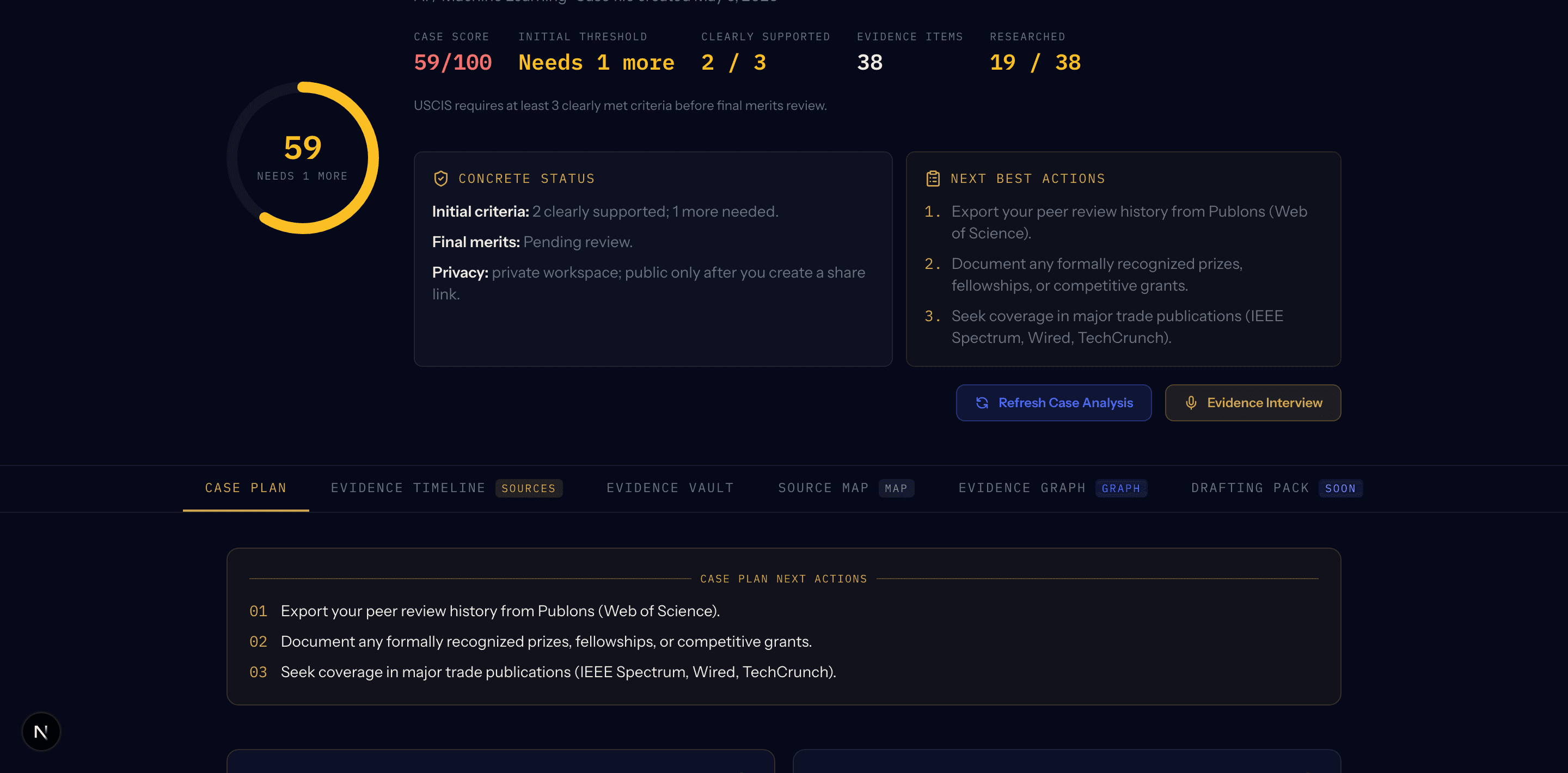
Timeline of You maps your background against all 10 EB-1A criteria and tells you where you stand — useful for both 'should I file now' and 'what do I build before filing' decisions.
The Math Is Unambiguous
An Indian engineer who qualifies for EB-1A and chooses not to pursue it, instead relying on an EB-2 employer sponsorship, is likely making the most expensive immigration decision of their life. The opportunity cost is measured in decades of employment constraints, career decisions made around visa status instead of professional growth, and the compounding value of not being a free agent in the labor market.
The qualification bar is real. Not everyone qualifies. But “qualifying for EB-1A” is far more achievable than most Indian engineers believe, and the assessment is worth doing before assuming you don't make the cut.
One more thing: the clock matters
EB-1 priority dates are currently current for India — but this could change. Congress has debated various immigration reform proposals that could affect EB-1 per-country limits. Current is not guaranteed forever. Filing sooner rather than later locks in today's priority date and protects against future policy changes. This is not hypothetical fearmongering — it's the reason immigration attorneys consistently advise filing as soon as you're ready.
Find out if you qualify — in 3 minutes
Free assessment maps your background against all 10 EB-1A criteria. Built for Indian tech workers who want a real answer, not a vague “you might qualify.”
Get my free EB-1A assessment →EB-1A Strategy Guide
Get notified when we publish new guides
Practical EB-1A strategy for researchers, engineers, and founders. No spam.
Related Guides
EB-1A vs NIW: Which Green Card Route Is Right for You?
Both paths skip employer sponsorship. Here's how to decide which fits your profile — and why some people file both.
9 min →
EB-1A for Tech Workers and AI Researchers: A Practical Guide
How engineers, ML researchers, and technical leads can build a compelling EB-1A case — which criteria map best to a tech career.
10 min →
Do I Qualify for EB-1A? The Honest Eligibility Checklist
Most people are wrong about their EB-1A chances — in both directions. Here's the concrete checklist USCIS actually uses.
8 min →