EB-1A Processing Time in 2026: What the Data Actually Shows
Last updated: May 17, 2026 · 7 min read
By the Timeline of You team · 7 min read
People ask two questions about EB-1A processing time. The first is “how long will it take?” The honest answer is: it depends on whether you pay $2,805 for premium processing. The second is “when can I actually stop worrying about my employer sponsoring my visa?” That answer is longer and more interesting.
Let's go through the actual numbers first, then the strategy.
I-140 Processing: Regular vs. Premium
The I-140 is the petition where USCIS decides whether you qualify as an alien of extraordinary ability. Everything downstream — your green card, your work authorization, your ability to change jobs — depends on this approval.
As of mid-2026, USCIS reports the following processing times at the two service centers that handle EB-1A:
Nebraska Service Center
12–22 months
15 business days
Texas Service Center
8–18 months
15 business days
Service Center
Regular Processing
Premium Processing
Note that USCIS doesn't let you choose your service center — they assign it based on your employer's location (for employer-sponsored cases) or the filing address on the form. For self-petitions, check which center is currently faster before filing.
Premium processing costs $2,805 (as of 2026, fee subject to annual increases) and guarantees USCIS will either approve, deny, or issue an RFE within 15 business days — roughly 3 weeks. They cannot pocket your money and stall. If they miss the deadline, you get the fee refunded and they still process your case.
Is Premium Processing Worth It?
For most people in tech: yes. And not just because of the time savings.
Here's the underappreciated reason. When USCIS issues a premium processing approval, the officer had to make a definitive decision in 3 weeks. That means less time for second-guessing, less time for additional internal review, and — in practice — slightly higher approval rates on clean petitions. The time pressure works in your favor if your case is strong.
Conversely, if your case has gaps, premium processing will surface them faster via RFE. That might feel bad, but consider: you get the RFE in 3 weeks instead of 14 months. You respond, and you're done in ~6 months total instead of 2+ years. The RFE under premium isn't a signal your case is weaker — it's just faster feedback.
The real cost comparison
If regular processing takes 18 months and premium takes 3 months, you're buying 15 months of certainty for $2,805. If your salary is $250K, that's roughly $300K in income you're living under employment-visa constraints during — constrained job flexibility, no side income, employer dependency. The $2,805 is not even a rounding error.
What Actually Delays a Case
USCIS processing time estimates are medians. The actual distribution has a long tail. Cases get delayed for specific reasons — and most of them are predictable in advance.
RFE (Request for Evidence): Roughly 30–36% of EB-1A petitions receive an RFE. You have 87 days to respond. A well-prepared response takes 6–10 weeks. Add this to your timeline. The good news: a well-responded RFE approves at 60–70%, so it's not a death sentence.
Name check delays: USCIS runs FBI name checks. Certain name combinations, countries of birth, or travel history can trigger additional review that takes weeks to months. There's not much you can do to predict or prevent this.
Missing documentation: Filing an incomplete petition doesn't get automatically rejected — USCIS sometimes issues an RFE to fill in gaps. This adds months. The fix is filing a complete petition the first time.
Biometrics and interview scheduling: On the I-485 (adjustment of status) side, USCIS may schedule a biometrics appointment and sometimes an interview. Most I-485 applicants in EB-1 categories get their interviews waived in practice, but scheduling delays can add 3–6 months in busy field offices.
The Full Timeline: Filing to Green Card in Hand
Here's the complete sequence. EB-1A is a two-step process: first you get the I-140 approved (proving you qualify), then you adjust status via I-485 (actually getting the green card).
The critical fact for EB-1A: priority dates are current for all countries of birth, including India and China. This means you can file the I-485 immediately after I-140 approval — or even concurrently with the I-140 if you're already in the US. You don't wait in a backlog.
Prepare petition
4–12 weeks
Gathering evidence, letters, attorney review
File I-140 (regular)
8–22 months
Nebraska/Texas Service Centers
File I-140 (premium)
15 business days
$2,805 fee; guaranteed adjudication
RFE response (if issued)
+2–4 months
87-day deadline to respond
File I-485 (AOS)
File immediately after I-140 approval
EB-1 priority dates current for all countries
EAD / Advance Parole
3–6 months after I-485
Work authorization independent of employer
I-485 approval (green card)
8–18 months after filing
Biometrics, interview (sometimes waived), background check
Running the math on a typical case with premium processing: file today, I-140 approval in ~3 weeks, file I-485 concurrently (or within days of approval), get EAD in 3–4 months, get green card in 12–18 months total from first filing. That's genuinely achievable.
With regular processing and no RFE: more like 20–30 months. With an RFE under regular processing: 30–40 months. The variance is real.
The EAD: Why It Matters
When you file the I-485, you can simultaneously file for an Employment Authorization Document (EAD) and Advance Parole (travel document). USCIS typically issues EAD within 3–6 months of I-485 filing.
Once you have the EAD, you can work for any employer — or no employer, or yourself — without needing H-1B sponsorship. This is the practical moment of freedom, often 6–9 months before the green card itself arrives.
For engineers on H-1B who've been locked into a single employer, this is a significant milestone. You can take a startup equity role, go independent, or simply negotiate from a position of strength knowing you're not dependent on your employer's continued sponsorship.
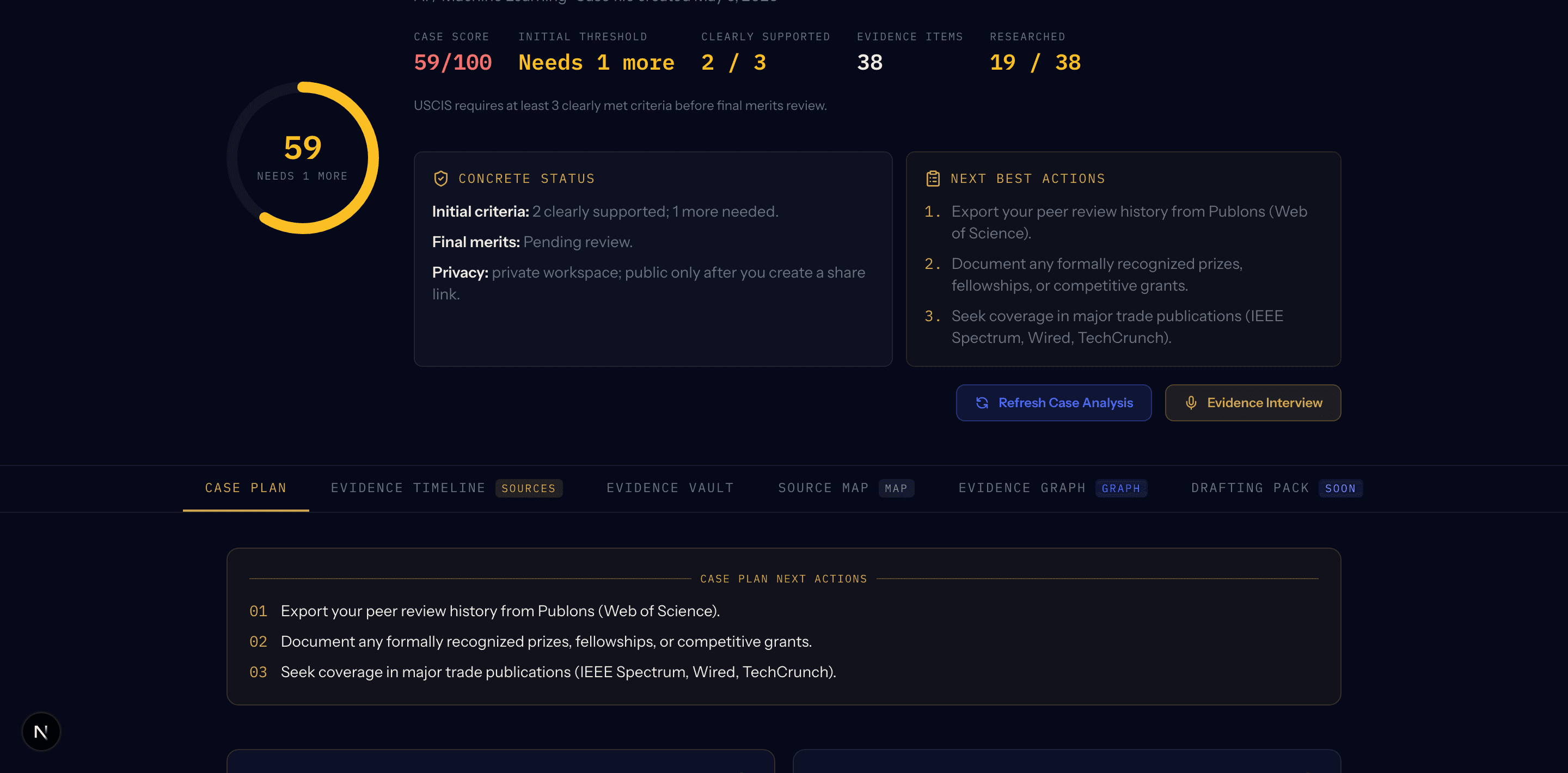
Timeline of You maps your evidence against all 10 criteria so you can see exactly where you stand before filing — reducing RFE risk and helping you decide whether premium processing makes sense.
A Note on Indian Nationals
Unlike EB-2 and EB-3 (where Indian-born applicants face backlogs measured in decades), EB-1 priority dates are currently current for India. This is a major reason why qualifying for EB-1A is so strategically important for Indian engineers specifically. The same person who would wait 50+ years for an EB-2 NIW green card can potentially have an EB-1A green card in 18 months.
The catch is actually qualifying. But “actually qualifying” is more achievable than most people think — and that's the work worth doing.
How to Track Your Case After Filing
After filing, you get a receipt notice with a case number. You can track status on the USCIS case status portal (egov.uscis.gov) and sign up for text/email notifications. For premium processing cases, the 15-day clock starts from when USCIS accepts your payment — usually 2–3 days after USPS delivery.
If your case passes the USCIS published processing time without action, you can submit a case inquiry. For premium processing cases that exceed 15 business days, submit a service request immediately — you're entitled to a fee refund.
Bottom line on timing
If you qualify for EB-1A and have a clean petition, premium processing gets you an I-140 decision in 3 weeks. From there, file I-485 concurrently, get EAD in 3–6 months, and the green card typically follows within 12–18 months of initial filing. The total window — 12 to 18 months — is dramatically faster than any other path available to Indian or Chinese nationals in the employment-based green card system.
See where you stand before you file
Free assessment maps your background against all 10 EB-1A criteria — takes 3 minutes. Know whether you're ready to file now, or what to build before filing.
Get my free EB-1A assessment →EB-1A Strategy Guide
Get notified when we publish new guides
Practical EB-1A strategy for researchers, engineers, and founders. No spam.
Related Guides
EB-1A Approval Rates: What the Data Actually Shows
USCIS approval rates for EB-1A broken down by year, field, and petition type — and what the numbers mean for your case.
6 min →
Getting an EB-1A RFE: What It Means and How to Respond
~35% of EB-1A petitions get a Request for Evidence. Here's what officers are actually asking for and how to respond without panicking.
8 min →
Filing EB-1A Without an Attorney: What's Actually Involved
EB-1A self-petitions are legal and increasingly common. Here's what pro se filing actually requires and where people get it wrong.
8 min →